

The hidden cost of unarticulated brand DNA
I had the idea of using colour to describe brand DNA in a very simplistic form, so here goes – I hope it makes sense....

Visualise the scenario - a guy starts a business (I'll call him Bob). As we typically find, and as you might recognise in your own business, there's a lot of himself in the brand - his values, his personality, his way of being, all automatically become the brand's. He instinctively makes the right decisions for his brand naturally, because they are based on his own values. Let's call this ‘latent DNA’ 'purple'.
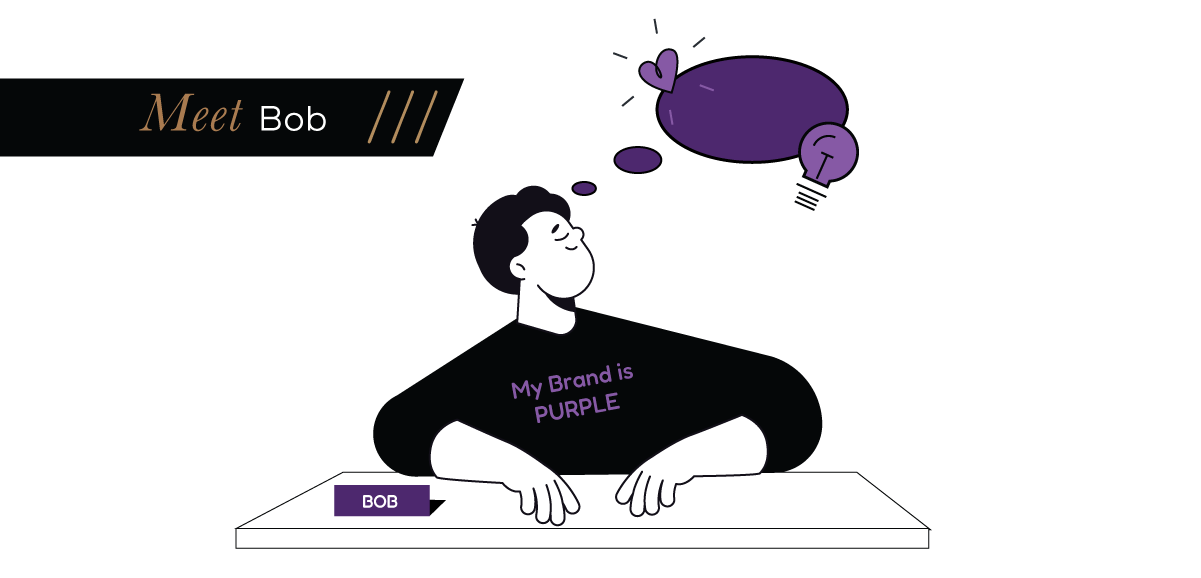
Note: It's important to point out at this stage, that I am using the simplicity of a single colour to represent the whole brand essence, vision, purpose, language, and style, rather than suggesting that purple is the brand or logo colour. Colour in this story is purely a simplistic vehicle to communicate the brand’s identity and aura.
OK - back to Bob’s ‘purple’ brand.
Now, Bob has never articulated its values and brand style, even to himself - it's been a natural, subliminal process. So, let’s fast forward a year or two. The business is growing, and Bob decides to take on a business partner - Jess.
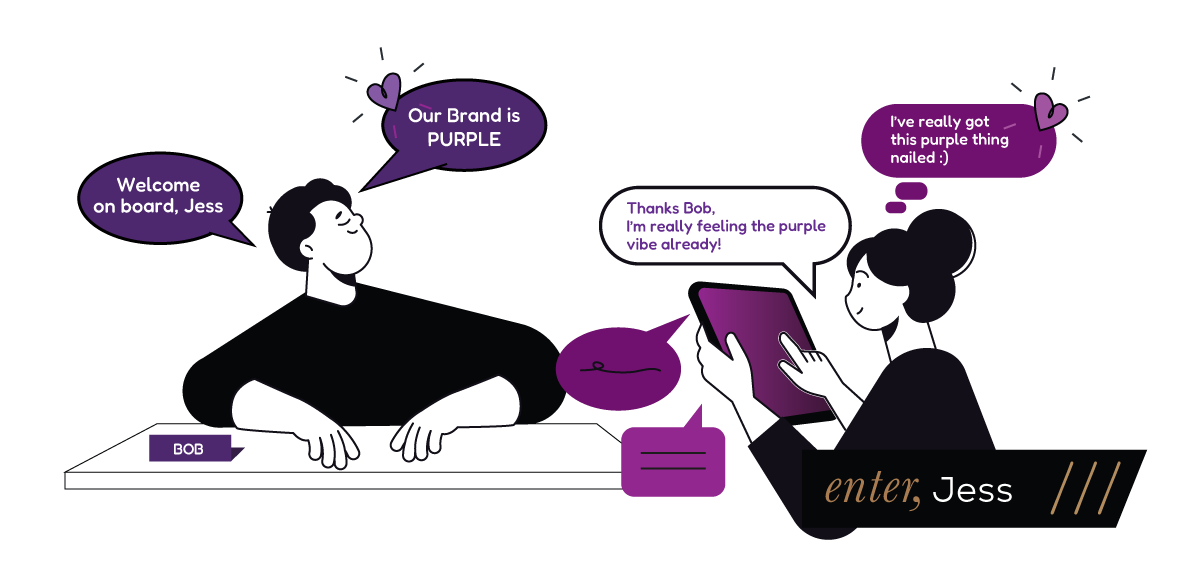
Bob and Jess have similar values and share a mutual vision for the business. Bob attempts to convey to Jess how the brand is purple. Let's say in Bob's mind's eye, this is a dark blueish purple. But because Bob hasn't fully articulated the intricacies and nuances of his brand DNA, Jess, quite naturally envisions her own version of purple. In her mind's eye, the brand is a rich, warm purple, edging towards red.
Neither of them is aware of what the other envisions, and they simply get on with the business of – well… doing business.
Further down the track, things are going well, and they begin to take on staff - a few on Bob's team and a few more on Jess's team. Both partners attempt the same process of imparting the brand's DNA.
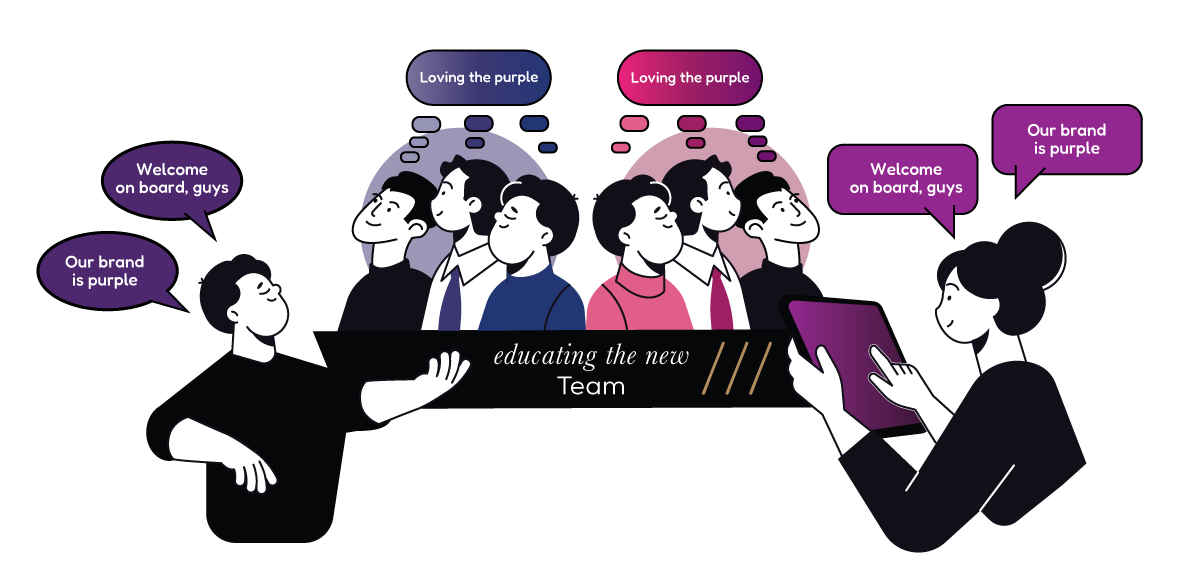
(At this point, I should mention that neither of them even understands the concept of DNA, so what I mean by this is that they are trying to somehow communicate what the brand is about and how it should appear to the market at large, and to their target audience in particular).
Bob, with his blue hued brand vision, will communicate this with his own natural personality and values, but it's highly unlikely that the two new recruits will share these values and traits - each having entirely different points of view and life experiences. So now what happens, is that Bob's team members, both have slightly different tones of his perception of purple. Maybe one is even more blue, while the other envisions something a little lighter in tone - more of a soft violet, perhaps.
We can replicate this observation with Jess's team - one of her new hires may see a more extreme version of the warm purple in Jess's mind, edging toward a burgundy colour, while the other might mentally conjure a brighter, pink-tinged purple.
Now to throw in a real red herring (literally).
Leaping ahead in the business’s development timeline, the team expands again, and in an effort to really lift the business to the next level, they bring in a young hot-shot sales manager.
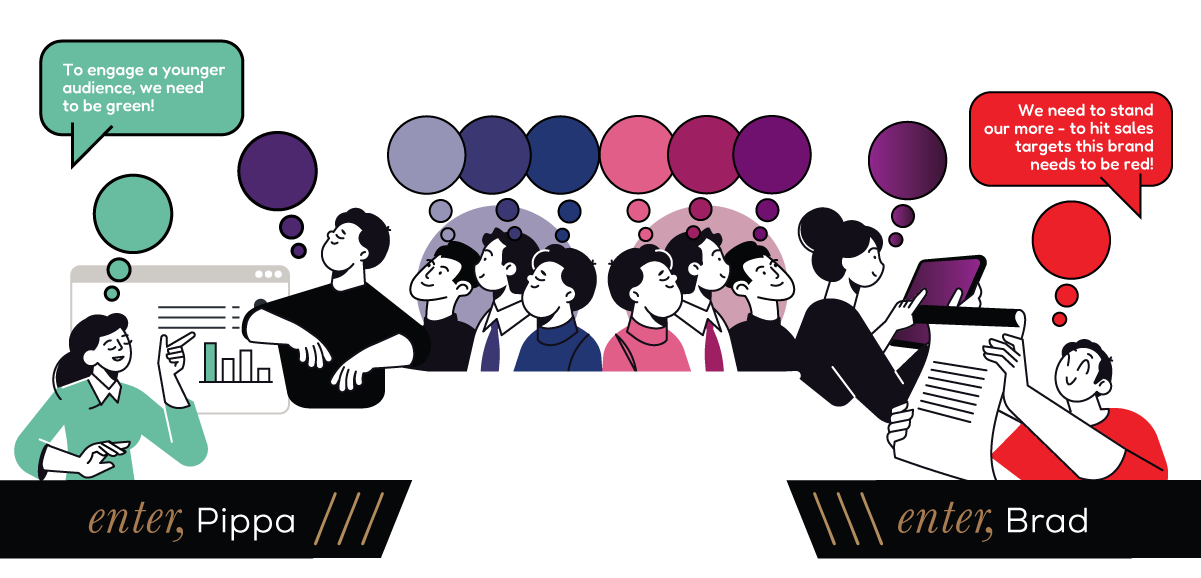
Both Bob and Jess attempt to impart their ‘brand knowledge’ to the new guy - I think he sounds like a Brad ;).
“Oh no,” says Brad, “I don't think this brand is purple at all - it's clearly red! That's the direction we need to be heading if we really want this business to fly.” Bob and Jess are open to new ideas, so they go along with it. But Brad (just as Bob and Jess before him) can't quite verbally, or visually articulate exactly what kind of red this brand is.
He steams ahead regardless, and hires a sales team, who, through the same muddled process, each envision their own perceived hue of the brand red.
Meanwhile the original team members, each struggle to ditch their version of purple entirely, while trying to partially embrace Brad’s ‘red’ vision, hence various blended shades begin to emerge.
To further support the team, Pippa is brought into the business as Head of Strategy. It’s her strong belief, fully supported by market research, that the brand must advance in a ‘green’ direction to move with the times and stay relevant to younger consumers.
So now, as the team – and the management – are still wrestling unsuccessfully with the ‘red’ curveball, they additionally, must contend with (and attempt to make sense of) Pippa’s ‘green’ directive.

Ultimately, the result is an unholy mess of jarring colours, blurred and muddied into various shades of sludge, resulting in startlingly mixed messages, unfocused direction, and a total lack of brand clarity.
It’s not just that the brand is unlikely to resonate in the market – the team has no distinct cultural direction. Not one existing or potential stakeholder can harness and exude the brand essence required for success.
None of this was malicious.
No one set out to dilute the brand.
Everyone was acting with the best of intentions. Each individual believed they were strengthening the business, making it more relevant, more competitive, more progressive. Every decision made sense in isolation. But without a clearly defined foundation to anchor those decisions, they began to pull in different directions. Slowly, almost imperceptibly, the brand lost its centre.
As the misalignment becomes impossible to ignore, the team feels it first. Confusion replaces clarity. Motivation dips. Without a shared sense of direction, even capable people begin to hesitate. The owners feel deflated and lost, and customers have lost faith in the business - or are no longer attracted to it. Bob and Jess, being closest to the original (unarticulated) vision are desperately trying to get their arms around the brand to protect their business and arrest the erosion of their brand integrity, while fending off fierce resistance from the reformers.
Building the business has become a combat sport and every single player is thoroughly exhausted. The one party who is blissfully unaffected by this maelstrom is their customer. They simply don’t care enough - and attempting to discern whether or not this brand is for them is thrown into the “too hard basket”. They shed the association and move on – no doubt attracted by a business that has its brand act together.
If the team cannot clearly define and communicate your brand DNA with passion and conviction, what chance do your prospects have of even beginning to engage with it? Given that the first time any human comes across a brand, they will likely have no recall of it – even when it’s clear and distinctive - an unfocused brand has little chance getting noticed.

Research and statistics demonstrate time and again, that prospects will need to see a consistent version of said brand a minimum of eight times before it even registers in their consciousness – double that, before they are inspired to take even the smallest action, such as liking a social media post.
Just imagine how difficult you are making brand recognition for your audience if every touchpoint delivers a different message or experience. You will be extending that recall time, tenfold – and even then, the perception of your brand is unlikely to resonate positively.
It's challenging, even for consistent brands, to achieve cut through, when they are confidently blasting (let’s say ‘yellow’ in this instance) across every conceivable touchpoint in exactly the right tone. Imagine the impossible task a brand faces with the mixed messaging described in Bob and Jess’s scenario. Their would-be customers simply have virtually no chance of recall.
The biggest threat to growing a brand isn't competition; it’s internal dilution. An inevitable path to tread without that essential clarity of vision.

If any of this sounds familiar, you may find my recent article, Brand before Marketing helpful to give you some guidance in re-capturing and both visually and verbally articulating your brand vision as a team. (You’ll also find it right below this post),
It might take a little time, but stick with the process, and don’t lose heart – it’s really not as difficult as it may seem to rekindle that original brand flame and bring your whole team into your vision – trust me, they will thank you for it.
Now is the time to get back to basics, take a very deep dive under the skin of your brand and get right to the heart of it.
Defining exactly what you love about your brand will help others to love it too.
Always remember that emotions drive purchasing decisions every time. You must connect with your authentic values, to articulate, document, and consistently drive your vision through every aspect, and into every tiny corner of your business. Then share it will the world.
Good luck! And if you need help, you know where to find me…